
How to Plant a Palm Tree: Depth, Watering and Care for Gardens and Pots
How to plant a palm tree the right way: choosing cold hardy palm trees for your climate, how deep to plant a palm tree, watering and bracing new palms, growing palm trees in pots on the patio, and simple palm tree care for fertilizing, pruning and winter protection.
Affiliate disclosure: This guide links to our buying guides, which contain affiliate links. As an Amazon Associate, we earn from qualifying purchases at no additional cost to you.
Nothing says outdoor living like a palm tree beside a pool or patio. Palms are surprisingly easy to grow once they are established, but they are planted and cared for differently from ordinary trees. Planting too deep, overwatering, using the wrong fertilizer and cutting off too many fronds are the most common reasons palms struggle.
This guide explains how to plant a palm tree step by step. You will learn which cold hardy palm trees suit cooler regions, exactly how deep to plant a palm tree, how to water and brace a new palm, how to grow palm trees in pots, and how to handle palm tree care such as fertilizing, pruning, mulching and winter protection.
Choosing the Right Palm
The most important decision when learning how to plant a palm tree is choosing a species that survives your winters. Palms range from very cold hardy shrubs to tropical trees that cannot tolerate any frost.
| Situation | Good choice |
|---|---|
| Cold winters (occasional single digits °F) | Needle palm, windmill palm, dwarf palmetto |
| Mild winters (rarely below the mid-20s °F) | Cabbage palm, jelly palm |
| Frost-free climates | Most tropical palms |
| Cold climates, but you want a palm | A tropical palm in a pot that moves indoors for winter |
| Small garden or courtyard | Clumping or slow-growing species |
The old version of this page described Phoenix, fan, lady and Washingtonia palms as easy to grow almost anywhere. In reality, hardiness differs greatly between species, so always check the minimum temperature before you buy.
Cold Hardy Palm Trees
The University of Georgia describes these cold hardy palm trees:
| Palm | Cold tolerance (UGA) | Size and notes (UGA) |
|---|---|---|
| Needle palm (Rhapidophyllum hystrix) | One of the hardiest; reported to survive about -5°F | About 5 feet tall and wide; prefers inland sites over salt spray |
| Windmill palm (Trachycarpus fortunei) | Reported to survive about -10°F | 20 to 25 feet; attractive in groups of three to five; tidy near pools |
| Dwarf palmetto (Sabal minor) | Reported to withstand about 10°F | 4 to 5 feet; likes moist, sunny sites |
| Cabbage palm (Sabal palmetto) | Needs protection below about 25°F | Plant in a sheltered spot, such as the southeast side of a building |
| Jelly palm (Butia capitata) | Needs protection below about 25°F | Up to about 30 feet |
Young palms are usually less cold tolerant than established ones, and the figures above are survival temperatures, not guarantees of a perfect-looking palm. In borderline climates, plant in a sheltered, sunny spot near a wall.
When to Plant a Palm Tree
Palms grow roots best in warm soil. The University of Florida IFAS notes that, in Florida, planting during the rainy season (June to November) increases transplant survival. In cooler regions, the general rule is to plant in late spring or early summer, once the soil has warmed, so the palm has a full warm season to establish before winter.
How Deep to Plant a Palm Tree
Getting the depth right is the single most important step. The University of Florida IFAS gives this guidance:
| Type of palm | How deep to plant (UF/IFAS) |
|---|---|
| Field-grown (dug from the ground) | At the same depth at which it was previously growing |
| Container-grown | With the top of the root-shoot interface about 1 inch below the soil surface |
So how deep to plant a palm tree? No deeper than it grew before. The University of Florida IFAS warns that deep planting, or piling mulch against the trunk, can lead to root suffocation and decline. The base of the trunk should remain visible.
How to Plant a Palm Tree Step by Step
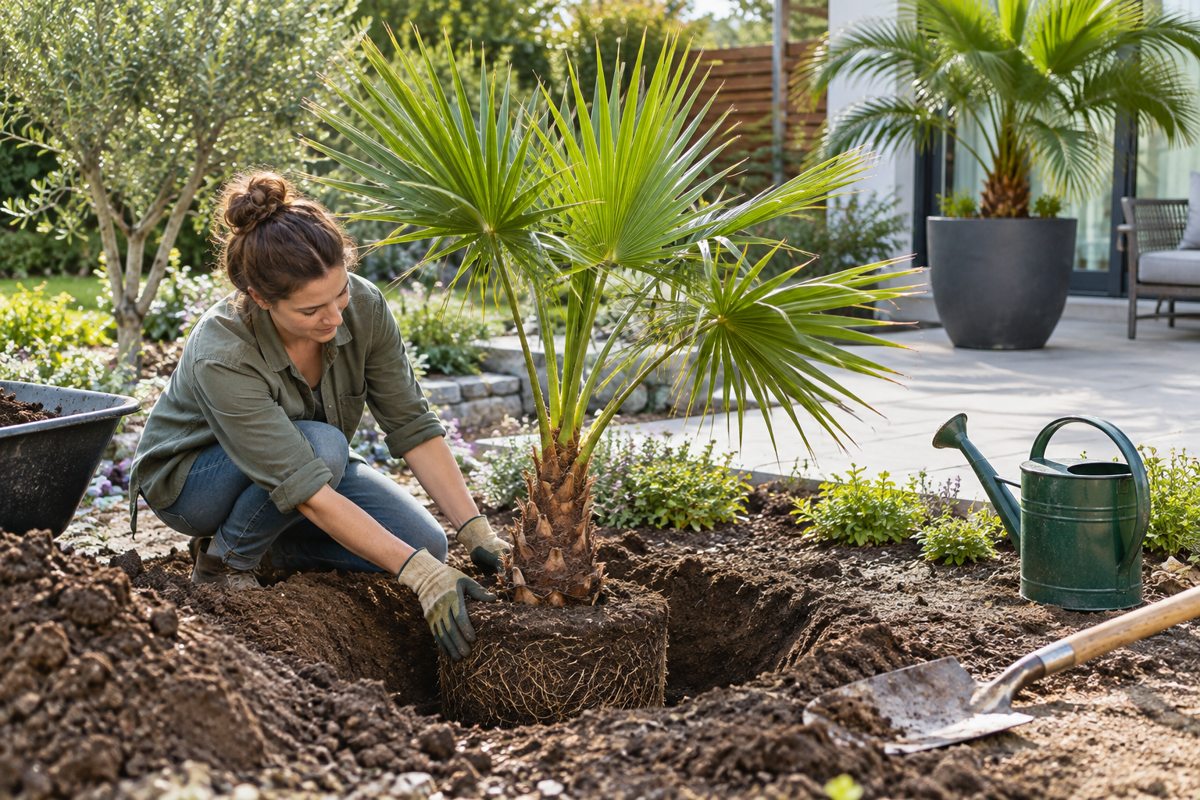
Here is how to plant a palm tree in seven steps, based on University of Florida IFAS guidance:
For tools to dig a large planting hole, see our gardening tool sets guide.
Bracing and Leaf Tying
- The University of Florida IFAS advises giving tall palms mechanical support for about a year.
- Never nail braces into the trunk; UF/IFAS recommends strapping short lengths of 2 x 4-inch lumber to the trunk and attaching the braces to those.
- Tying the leaves together after planting is common, but UF/IFAS research shows it provides no benefit to the palm and can encourage disease.
- Small palms that stand firmly do not need bracing.
Watering a New Palm Tree
| Type of palm | Watering after planting (UF/IFAS) |
|---|---|
| Container-grown | Keep irrigating until established, about six to eight months |
| Field-grown | Keep the soil uniformly moist, but never saturated, for about four to six months |
The old version of this page advised watering every two days in warm weather and, confusingly, “every 15 minutes” in cold weather. Fixed schedules do not work for palms: check the soil, water deeply when the top few inches begin to dry, and never keep the root zone waterlogged. After establishment, most landscape palms need water only during long dry spells. The University of Florida IFAS also advises avoiding overwatering. See our garden hose nozzle guide and how often to water your garden.
Growing Palm Trees in Pots
Palm trees in pots are perfect for patios, balconies and pool areas, and they let you grow tropical palms in cold climates by bringing them indoors for winter. These tips follow general container care practice:
| Tip | Details |
|---|---|
| Pot size | Choose a pot a little wider than the root ball; move up one size every few years |
| Drainage | Drainage holes are essential; do not add a gravel layer at the bottom |
| Mix | A well-drained potting mix, for example one sold for palms or cacti mixed with regular potting mix |
| Depth | Keep the palm at the same depth as before; do not bury the trunk |
| Watering | Water when the top inch or two of mix is dry, until water runs out of the bottom |
| Feeding | A slow-release palm fertilizer in the growing season |
| Winter | Bring tender palms indoors before frost; place them in bright light |
Palm trees in pots dry out faster than palms in the ground, so check them more often in summer. The old version of this page recommended a 5 cm layer of clay pebbles or stones at the bottom of the pot. Research shows that a gravel layer actually keeps the soil above it wetter; see our article on gardening myths. For more on pots and potting mix, see our container gardening guide.
Palm Tree Care: Fertilizing
Good palm tree care starts with the right fertilizer, because palms have special nutrient needs. University of Florida IFAS Extension recommends a palm fertilizer with an analysis of 8-2-12-4 (nitrogen, phosphorus, potassium, magnesium), with all nutrients in slow-release form.
| Point | Details (UF/IFAS) |
|---|---|
| Fertilizer type | 8-2-12-4Mg, slow or controlled release |
| Rate and timing (North Florida example) | About 1.5 pounds per 100 square feet, twice a year (May and late August or early September) |
| Rate and timing (South Florida example) | About 15 pounds per 1,000 square feet of plant bed, four times a year |
| Common deficiencies | Potassium and magnesium: older leaves yellow, brown and die off |
| Lawn fertilizer | Keep it away from the palm root zone, which extends many feet beyond the canopy |
| Wrong fertilizer? | UF/IFAS notes it is better not to fertilize palms at all than to use the wrong formulation |
Rates and timing vary by region; outside Florida, follow the product label and your local extension office. Recovery from nutrient deficiencies can take months.
Palm Tree Care: Pruning
Palm tree care usually means pruning less than you might expect:
- UF/IFAS advises not removing green fronds that originate at or above horizontal (the 9 o’clock to 3 o’clock positions).
- Removing too many green fronds reduces the palm’s ability to make food and, according to UF/IFAS, can predispose the bud to wind damage.
- Remove only dead fronds, and flower or fruit stalks if they are a nuisance.
- Yellow older fronds are often a sign of potassium deficiency; removing them does not fix the problem, and the palm uses their nutrients.
- Use clean, sharp tools, and avoid climbing spikes, which leave permanent wounds in the trunk (general arboricultural practice).
For pruning tools, see our gardening tool sets guide and gardening gloves guide; many palms have sharp leaf bases.
Mulching Palms
- A layer of mulch over the root zone keeps soil moist and reduces weeds.
- UF/IFAS warns not to mulch too deeply and not to let mulch touch the trunk.
- The base of the trunk should flare out and be visible at all times (UF/IFAS).
- Keep lawn grass and string trimmers away from the trunk; palm trunks cannot repair wounds the way other trees do.
A battery weed eater with a guard helps you trim around palms without hitting the trunk.
Winter Protection for Palms
Even cold hardy palm trees can be damaged when young or during an unusual cold snap. For palms at the edge of their hardiness, the University of Georgia describes wrapping the fronds and the central bud in blankets when temperatures fall below about 25°F, or tying the fronds together in bundles and covering them with burlap or blankets. Protecting the central bud is critical, because a palm cannot grow a new one.
- Water well before a freeze; moist soil holds more heat than dry soil.
- Remove covers once temperatures rise again.
- Do not cut off cold-damaged fronds immediately; wait until new growth appears in spring.
- Move potted palms indoors or into a garage before frost.
For more winter tips, see how to winterize your garden.
Common Palm Tree Problems
| Problem | Likely cause | Solution |
|---|---|---|
| Yellowing older fronds | Potassium or magnesium deficiency | Use an 8-2-12-4Mg slow-release palm fertilizer |
| Slow decline after planting | Planted too deep or mulch against the trunk | Expose the trunk flare; avoid deep planting |
| Brown, collapsed spear leaf | Cold damage or bud rot | Protect the bud; avoid overwatering |
| Weak, pencil-thin top of the trunk | Over-pruning or poor nutrition | Stop removing green fronds; fertilize correctly |
| Wilting new transplant | Too little water or root loss | Keep soil uniformly moist for the first months |
Popular Palms for Patios and Pots
Not every palm is suited to life in a container, so palm tree care starts with choosing the right species. These palms are widely grown in pots on patios and balconies (general horticultural knowledge); check the cold hardiness for your area before leaving them outdoors in winter:
| Palm | Why it suits pots | Notes |
|---|---|---|
| Lady palm (Rhapis) | Slow-growing, clumping, tolerates shade | Good for shaded patios and indoors |
| Parlor palm (Chamaedorea elegans) | Small and compact | Mainly indoors or in shade outdoors in summer |
| Pygmy date palm (Phoenix roebelenii) | Small, elegant, tropical look | Sharp spines at the leaf bases |
| Mediterranean fan palm (Chamaerops humilis) | Compact, clumping, tolerates sun and heat | One of the hardier palms for pots |
| Windmill palm (Trachycarpus fortunei) | Cold hardy, upright | Grows large over time; move to the ground later |
| Needle palm (Rhapidophyllum hystrix) | Very cold hardy, shrubby | Sharp needles; wear gloves |
A sago palm is not a true palm but a cycad, and all parts are toxic to pets and people. Keep it out of reach of dogs and cats.
Palm trees in pots with spiny leaf bases are best placed away from walkways and play areas. Whichever palm you choose, how to plant a palm tree in a pot follows the same rules as in the ground: the same depth as before, drainage holes and no waterlogging. Palm tree care in containers mainly means checking the soil more often and feeding in the growing season.
How to Plant a Palm Tree: Common Mistakes
| Mistake | Why it hurts | Better approach |
|---|---|---|
| Planting too deep | Root suffocation and decline (UF/IFAS) | Same depth as before, trunk base visible |
| Choosing a tender species for a cold area | Winter damage or death | Pick cold hardy palm trees or use pots |
| Using lawn fertilizer | Wrong nutrient forms for palms | Use a slow-release palm fertilizer |
| Removing green fronds | Weakens the palm | Remove only dead fronds |
| Gravel layer in pots | Keeps soil wetter | Drainage holes and the same mix throughout |
| Nailing braces to the trunk | Permanent trunk wounds | Strap wood blocks to the trunk |
What You Need
| Item | Why it helps | More information |
|---|---|---|
| Spade and hand tools | Digging a wide planting hole | See our gardening tool sets guide |
| Heavy-duty gloves | Protection from sharp leaf bases and spines | See our gardening gloves guide |
| Hose with adjustable nozzle | Deep watering of new palms | See our garden hose nozzle guide |
| Lightweight expandable hose | Watering palms in pots on the patio | See our expandable garden hose guide |
| Slow-release palm fertilizer (8-2-12-4Mg) | The right nutrients for palms | Follow the label |
| Frost cloth or burlap | Winter protection for borderline palms | Protect the central bud |
| Kneeling pad | Comfortable planting and mulching | See our kneeling pad guide |
Frequently Asked Questions
How do I plant a palm tree?
Dig a hole about twice as wide as the root ball but no deeper, set the palm at the same depth it grew before, backfill with native soil, wash soil into air pockets, brace tall palms and keep the soil uniformly moist for the first months.
How deep should I plant a palm tree?
At the same depth it grew before. For container palms, UF/IFAS advises setting the top of the root zone about 1 inch below the soil surface.
When is the best time to plant a palm tree?
In warm weather, when the soil is warm. In Florida, UF/IFAS notes that planting in the rainy season (June to November) improves survival.
How often should I water a newly planted palm?
Keep the soil uniformly moist, but never saturated, for about four to eight months depending on the type of palm. Check the soil instead of following a fixed schedule.
What are the most cold hardy palm trees?
Needle palm, windmill palm and dwarf palmetto are among the hardiest, according to the University of Georgia.
Can I grow palm trees in pots?
Yes. Use a pot with drainage holes and well-drained mix, keep the palm at the same depth, water when the top of the mix is dry and bring tender palms indoors for winter.
Should I put gravel in the bottom of a palm pot?
No. A gravel layer keeps the soil above it wetter. Use drainage holes and the same mix throughout the pot.
What is the best fertilizer for palm trees?
UF/IFAS recommends an 8-2-12-4Mg palm fertilizer with all nutrients in slow-release form.
Why are my palm’s older leaves turning yellow?
Often a potassium or magnesium deficiency. Use a proper slow-release palm fertilizer and be patient; recovery takes months.
Should I cut off yellow palm fronds?
Only once they are completely dead. Do not remove green fronds that point at or above horizontal.
Should I tie up palm leaves after planting?
UF/IFAS research shows that tying leaves provides no benefit to the palm and can encourage disease.
How fast do palm trees grow?
It depends on the species. Many palms grow slowly, especially when young or in containers, while others, such as windmill palms, eventually grow tall. Check the expected mature size before planting.
Is a sago palm a real palm?
No. The sago palm is a cycad, not a true palm, and all parts are toxic to pets and people.
Do I need to amend the soil when planting a palm?
No. UF/IFAS notes there is no scientific evidence that amending backfill benefits palms.
How do I protect a palm tree from frost?
Wrap the fronds and central bud, or tie the fronds together and cover them with burlap or blankets. Protecting the bud is critical.
Final Thoughts
Now you know how to plant a palm tree: choose a species that suits your climate, plant in warm weather and remember how deep to plant a palm tree, no deeper than before. Brace tall palms, water consistently but never waterlog the soil, and let the palm establish.
For long-term palm tree care, use a slow-release palm fertilizer, prune only dead fronds and keep mulch off the trunk. Choose cold hardy palm trees for cooler gardens, or enjoy palm trees in pots that spend summer on the patio and winter indoors.
Sources: University of Florida IFAS Extension: transplanting palms in the landscape (EP001); University of Florida IFAS Extension, Escambia County: not all palm fertilizers are the same; University of Florida IFAS Extension, Broward County: prescription for healthy palms; University of Georgia Cooperative Extension: cold-hardy palms grow throughout Georgia.
Back to contents ↑
