
Real vs. Artificial Christmas Tree: Pros, Cons and Which Is Better
Real vs. artificial Christmas tree compared on cost, environmental impact, safety, care and convenience, so you can choose the natural or artificial Christmas tree that suits your home.
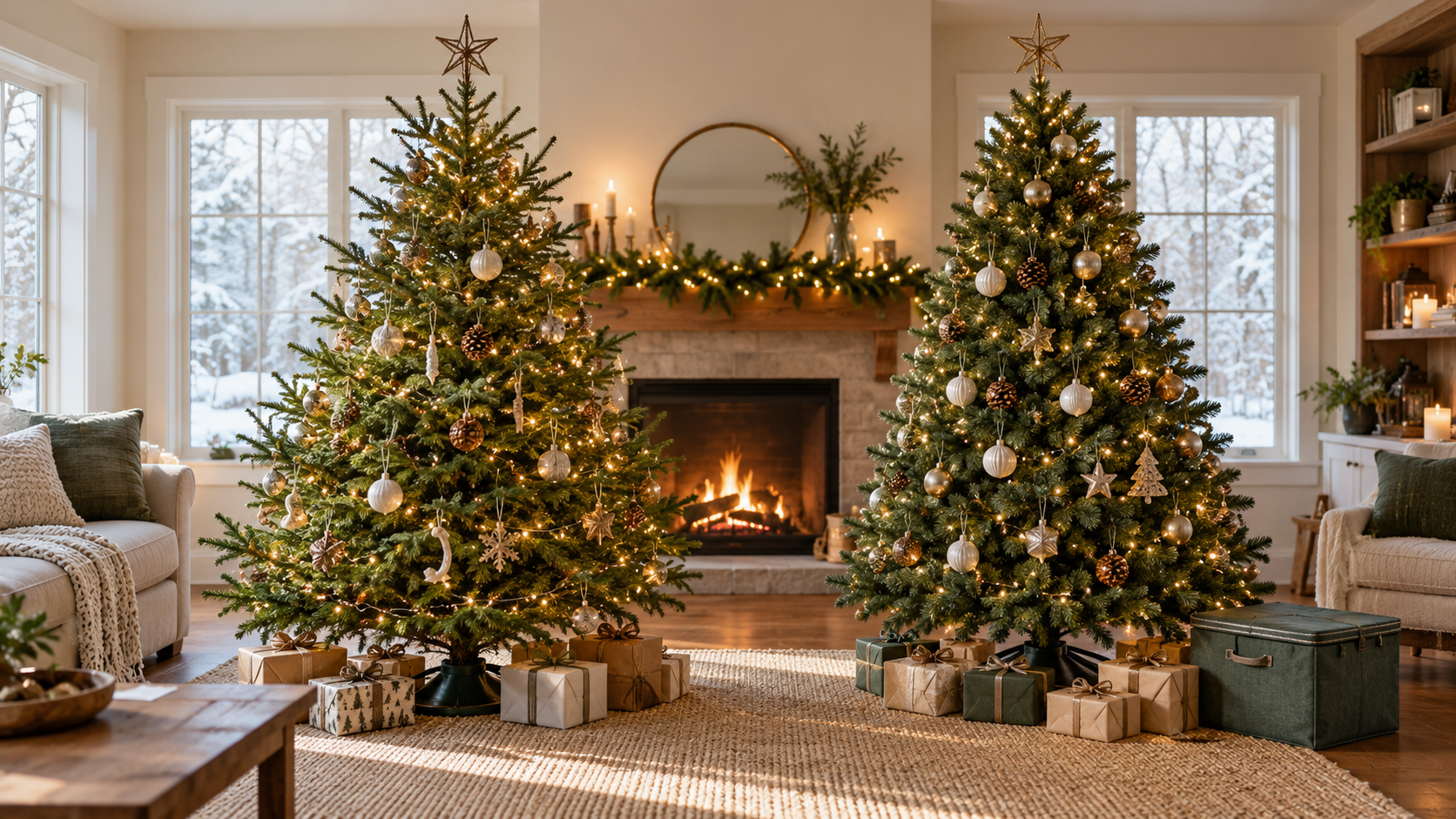
Affiliate disclosure: This guide links to our buying guides, which contain affiliate links. As an Amazon Associate, we earn from qualifying purchases at no additional cost to you.
Every year the same question comes up: real vs. artificial Christmas tree, which one is better? A real Christmas tree brings the scent of pine and fir into the house and can be recycled into mulch. An artificial Christmas tree is convenient, reusable and ready in minutes.
Neither choice is right for everyone. This guide compares the natural or artificial Christmas tree on cost, sustainability, safety, care and convenience, with a clear verdict for different situations. It also explains how to keep a Christmas tree fresh and what to do with it after the holidays.
Real vs. Artificial Christmas Tree at a Glance
| Factor | Real Christmas tree | Artificial Christmas tree |
|---|---|---|
| Look and scent | Natural shape and fresh pine or fir scent | Uniform shape, no scent |
| Cost | Pay every year | Higher upfront cost, then free for years |
| Care | Needs daily watering; drops needles | No watering; fluff branches once |
| Setup | Buy, transport and set up each year | Assemble from a box in under an hour |
| Environment | Grown on farms, compostable after use | Plastic and metal, usually not recyclable |
| Safety | Dry trees burn quickly; keep watered | Choose one labeled fire resistant |
| Storage | None; recycle after the holidays | Needs storage space for the box |
Real Christmas Tree: Pros and Cons
- The natural look and scent that many families love
- Grown on tree farms, where new trees are planted to replace harvested ones
- Can be recycled into mulch or compost after the holidays
- Supports local growers and a fun family outing to choose or cut the tree
- Needs water every day and drops needles
- A dried-out tree is a fire hazard
- You pay again every year and need to transport it
- Can trigger allergies in some people
Artificial Christmas Tree: Pros and Cons
- Reusable for many years, so it can cost less over time
- No watering, no needles on the floor
- Pre-lit models save time with lights
- Often a better choice for people with allergies to tree pollen or mold
- Made from plastic (often PVC) and metal, mostly manufactured overseas
- Usually cannot be recycled and ends up in a landfill
- No natural scent
- Needs storage space for the rest of the year
Real vs. Artificial Christmas Tree: Which Is Better for the Environment?
This is the most debated part of the natural or artificial Christmas tree question, and of the real vs. artificial Christmas tree debate in general. The answer depends mostly on how long you keep an artificial tree:
- Real trees are a farm crop. While they grow, they take up carbon dioxide, and after the holidays they can be chipped into mulch or composted.
- Artificial trees are made from plastics and metals that require oil and energy to produce and ship, and they usually end up in a landfill.
- The break-even point: according to Virginia Tech research, an artificial tree must be used for about 7 to 10 years before it has a lower environmental impact than buying a real tree every year.
- How you get the tree matters too: a long drive to a tree farm adds to the footprint of a real tree.
The greenest options: a locally grown real tree that you recycle as mulch, or an artificial tree you keep for 10 years or longer.
Cost Comparison: Natural or Artificial Christmas Tree
A real Christmas tree is a yearly cost, while an artificial Christmas tree is a one-time purchase. Over five or more years, a good artificial tree often costs less in total, especially a pre-lit one that also replaces a set of lights. A real tree has no storage cost and no risk of buying a model you do not like.
Want the look of real greenery without a full tree? Fresh wreaths, garlands and winter porch pots are affordable ways to add natural scent; see our outdoor Christmas decorating ideas.
Christmas Tree Safety
Safety is important whichever you choose. Fire safety organizations recommend:
- Keep the tree at least 3 feet away from fireplaces, radiators, heat vents, candles and space heaters.
- Real tree: water it every day. A dry tree catches fire much more quickly than a well-watered one.
- Artificial tree: choose one labeled fire resistant.
- Use lights labeled for indoor use on indoor trees, check them for damage and turn them off when you go to bed or leave the house.
- Make sure the tree cannot tip over and does not block exits.
Decorating outside too? Read how to use outdoor lights safely in our guide to the best outdoor Christmas lights.
Allergies, Pets and Children
- Allergies: some people react to pollen, mold spores or sap on a real tree. Shaking the tree outdoors and letting it dry for a day before bringing it in helps; an artificial tree avoids the problem.
- Pets: cats and dogs may drink the tree water or chew needles. Cover the stand and do not add chemicals to the water.
- Children: secure the tree so it cannot tip, and hang breakable ornaments and lights out of reach.
How to Choose a Real Christmas Tree
- Test for freshness: needles should bend and stay attached when you run a branch through your hand.
- Choose a species that holds its needles: Fraser fir, Douglas-fir and Scotch pine keep their needles well indoors.
- Measure first: check ceiling height and the space in the room, and leave room for the stand and the top ornament.
- Buy close to when you decorate: a tree cut close to Thanksgiving or cut yourself at a local farm stays fresh longest.
Best Real Christmas Tree Types
If you choose a real Christmas tree, the species makes a difference in scent, needle retention and branch strength:
| Tree | Known for | Good to know |
|---|---|---|
| Fraser fir | Excellent needle retention, sturdy branches | One of the most popular choices |
| Douglas-fir | Soft needles and a sweet scent | Holds needles well indoors |
| Balsam fir | Strong classic Christmas scent | Dark green, soft needles |
| Noble fir | Stiff branches for heavy ornaments | Often used for wreaths too |
| Scotch pine | Very good needle retention | Stiff branches; long-lasting |
| Colorado blue spruce | Blue-green color | Sharp needles; drops needles quickly if it dries out |
Whether you pick a natural or artificial Christmas tree, match the tree size to your room: measure the ceiling height and leave space for the stand and the topper.
How to Keep a Christmas Tree Fresh
Knowing how to keep a Christmas tree fresh makes a real tree look good for weeks and keeps it safer:
How to Choose an Artificial Christmas Tree
- Buy for the long term: a sturdy tree you like enough to keep for 10 years or more is the most sustainable choice.
- Check the label for fire resistance.
- Pre-lit or unlit: pre-lit saves time, but if a section of lights fails it can be hard to repair.
- Branch tips and shape: more tips give a fuller look; hinged branches are quicker to set up.
- Storage: keep it dry in its box or a storage bag.
A Living Christmas Tree in a Pot
A third option is a living tree in a pot or with a root ball, which you plant in the garden after the holidays:
- Keep it indoors for only about a week, in a cool room, so it does not break dormancy.
- Move it to a sheltered spot outside for a few days before planting.
- Dig the planting hole in fall, before the ground freezes, if you live in a cold region.
- Choose a species that suits your climate and the space it will need when mature.
A potted evergreen also looks great on the porch or patio; see our tips to enjoy your patio during winter.
Real vs. Artificial Christmas Tree for Small Spaces
In an apartment or small home, the choice often comes down to space and practicality:
- Slim or pencil trees: both real and artificial slim trees fit narrow corners; artificial versions are easier to find in exact sizes.
- Tabletop trees: a small potted evergreen or a compact artificial tree works well on a sideboard.
- Storage: if you have no storage space, a real tree or a small living tree avoids a large box in the closet.
- Balcony or porch: a potted evergreen with outdoor lights decorates the outside and saves space inside.
For lights on a balcony or porch, choose outdoor-rated sets; see our guide to the best outdoor Christmas lights.
After the Holidays: What to Do with Your Tree
- Real tree: many towns collect trees and turn them into mulch. You can also cut the branches and lay them over perennial beds as a light winter cover, or place the tree in the yard as shelter for birds.
- Remove everything first: lights, hooks, tinsel and ornaments must come off before recycling.
- Artificial tree: clean it, pack it dry and store it away from heat. When it is worn out, check whether it can be donated before you throw it away.
Using branches as winter protection is one of the tips in our checklist to winterize your garden, and wood chips make excellent mulch; see how mulch helps prevent weeds.
Real vs. Artificial Christmas Tree: Which Should You Choose?
| Choose a real Christmas tree if… | Choose an artificial Christmas tree if… |
|---|---|
| You love the natural scent and look | You want quick setup and no needles |
| You can water it every day | Someone in the house has allergies |
| You have a local tree farm or recycling program | You will keep the tree for 10 years or more |
| You do not have storage space | You have storage space for the box |
Frequently Asked Questions
Is a real or artificial Christmas tree better?
It depends on your priorities. A real Christmas tree offers scent and can be recycled; an artificial Christmas tree offers convenience and can be cheaper over time. Environmentally, an artificial tree needs 7 to 10 years of use to beat buying a real tree every year.
How long does a real Christmas tree last?
With a fresh cut and daily watering, a real tree usually stays fresh for about four to five weeks, depending on the species and the room temperature.
How do you keep a Christmas tree fresh longer?
Make a fresh cut at the base, use a stand that holds about 1 quart of water per inch of trunk diameter, water daily and keep the tree away from heat.
Do you need to add anything to Christmas tree water?
No. Plain tap water is enough. Keep the water level above the base of the trunk at all times.
Which Christmas tree holds its needles best?
Fraser fir, Douglas-fir and Scotch pine are known for good needle retention indoors.
Are artificial Christmas trees recyclable?
Usually not, because they combine plastic and metal. Keeping one for many years is the best way to reduce its impact.
Is a real Christmas tree a fire hazard?
A dry tree can burn quickly. A well-watered tree placed at least 3 feet from heat sources, with lights in good condition, is much safer.
Can I plant my Christmas tree after the holidays?
Only a living tree with roots in a pot or root ball. Keep it indoors for about a week at most and plant it before the ground freezes, or keep it in its pot in a sheltered spot.
Is a natural or artificial Christmas tree cheaper?
A natural tree costs money every year, while an artificial tree is a one-time purchase. Over five years or more, a good artificial tree often costs less in total.
What do I do with a real Christmas tree after Christmas?
Use your town’s tree collection or mulching program, put the branches over perennial beds as winter cover or set the tree in the yard as shelter for birds.
Final Thoughts
In the real vs. artificial Christmas tree debate, there is no single winner. A real Christmas tree is the natural choice for scent and recycling, while an artificial Christmas tree wins on convenience and can be the greener option if you keep it for many years.
Whichever you choose, keep it away from heat, water a real tree daily and check your lights. Then enjoy the season, inside and out in the garden.
Sources: Virginia Tech: how long you use your Christmas tree determines what you should buy; Penn State Extension: tips for selection and care of cut Christmas trees; Michigan State University: reuse artificial trees, compost natural ones; National Christmas Tree Association: care tips; NIST: holiday fire safety.
Back to contents ↑
