
ZZ Plant Care: Best Soil, Watering, Light and Propagation
Complete ZZ plant care: the best soil for ZZ plant, how often to water ZZ plant, light and temperature, repotting, ZZ plant propagation from leaves and division, and the honest answer to “is ZZ plant toxic?” for homes with children and pets.
Affiliate disclosure: This guide links to our buying guides, which contain affiliate links. As an Amazon Associate, we earn from qualifying purchases at no additional cost to you.
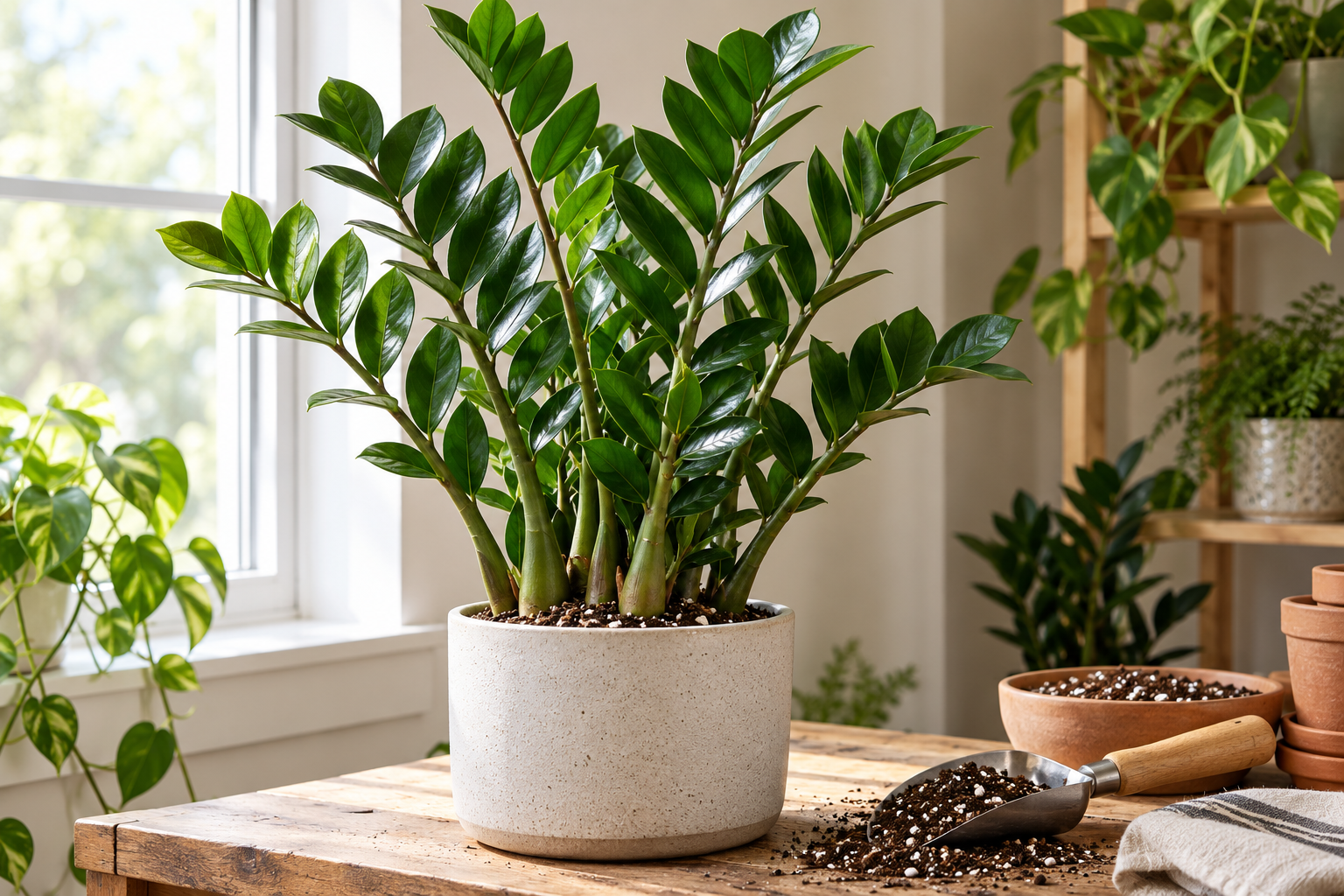
The ZZ plant (Zamioculcas zamiifolia) is famous for being almost impossible to kill. Its glossy, dark green leaves look good in low light, and its thick underground rhizomes store water, so it shrugs off a forgotten watering or two. The one thing it does not forgive is too much water.
This guide explains ZZ plant care step by step. You will learn the best soil for ZZ plant, how often to water ZZ plant through the seasons, how much light it needs, when to repot, how ZZ plant propagation works, and the honest answer to “is ZZ plant toxic?”. We also correct the old version of this page, which recommended watering at least twice a week.
About the ZZ Plant
| Fact | Details | Source |
|---|---|---|
| Botanical name | Zamioculcas zamiifolia | Iowa State, UConn |
| Origin | Africa (Iowa State: east Africa; UConn: South Africa) | Iowa State, UConn |
| Popularity | Became a popular houseplant in the 1990s | UConn |
| Water storage | Fleshy, starchy rhizomes at the base of the stems store water | UConn |
| Growth | Slow, in spurts | Iowa State |
| Size | About 3 feet tall | Iowa State |
The rhizomes are the secret behind the ZZ plant’s toughness: they act as water tanks. That is also why good ZZ plant care means watering less, not more.
How Much Light Does a ZZ Plant Need?
| Light | Effect | Source |
|---|---|---|
| Bright, indirect light | Best growth | Iowa State |
| Low light, including office lighting | Tolerated; growth is slower | Iowa State, UConn |
| Direct afternoon sun | Can damage the leaves | Iowa State |
| Direct sun | Not tolerated, except perhaps an east window in winter | UConn |
The old version of this page said a ZZ plant “accepts being without light”. It tolerates very low light, but it still needs some light to grow. In a dark corner it survives, but it stops producing new shoots. Excessive light causes scalding, curling, yellowing and browning of the leaves, according to UConn.
How Often to Water ZZ Plant
Iowa State advises watering thoroughly, so that some water flows out of the bottom of the pot, and then letting the soil dry before watering again. A thorough watering every 7 to 14 days is usually fine. UConn adds that overwatering is just about the only factor that leads to the demise of this tough houseplant.
| Situation | How often to water ZZ plant (starting point) |
|---|---|
| Bright room, spring and summer | About every 1 to 2 weeks, when the soil is dry (Iowa State) |
| Low light | Less often; check the soil before watering |
| Fall and winter | Less often, as growth slows |
| Freshly repotted | Wait a few days, then water thoroughly once |
The old version of this page recommended watering “at least twice a week”. For a ZZ plant, that is a recipe for rotting rhizomes. Iowa State warns that problems develop if the plant is watered too frequently and the potting soil is constantly wet.
The Best Soil for ZZ Plant
The sources do not prescribe one exact recipe, but they agree on the goal: soil that never stays wet. These options follow general potting practice:
| Option | Mix | Why |
|---|---|---|
| Simple | Good-quality indoor potting mix plus extra perlite (roughly one part perlite to two or three parts mix) | Better drainage and air around the rhizomes |
| Gritty | Potting mix mixed with cactus and succulent mix | Dries out faster |
| Chunky | Potting mix with some fine bark and perlite | Very good air flow |
The old version of this page recommended a mix with ordinary garden soil. Garden soil compacts in containers and drains poorly, which is the opposite of what a ZZ plant needs. The best soil for ZZ plant is a light, well-drained potting mix in a pot with drainage holes. Do not add a gravel layer at the bottom; it does not improve drainage, as we explain in our gardening myths article.
Pots and Repotting
- Always use a pot with drainage holes.
- Repot only when the rhizomes fill the pot or start to distort a plastic pot, usually every few years for this slow grower.
- Choose a pot only slightly larger than the old one; too much soil stays wet.
- Repot in spring or early summer, when the plant is growing.
- Plant the rhizomes at the same depth as before, just below the surface.
These repotting tips follow general houseplant practice. For more on pots, see our container gardening guide.
Temperature and Humidity
UConn advises keeping ZZ plants between 55 and 80°F and notes that they grow faster at warmer temperatures. Normal indoor humidity is fine. The old version of this page claimed the plant needs temperatures above 25°C (77°F); in fact, ordinary room temperatures suit it well. Keep it away from cold drafts and from direct contact with heaters.
Fertilizing a ZZ Plant
| Source | Advice |
|---|---|
| Iowa State | In spring and summer, fertilize once or twice a month with a dilute fertilizer solution |
| UConn | Fertilize once or twice during the growing season with a balanced houseplant fertilizer at half strength, or once every six months at full strength |
Both agree on light feeding in the growing season only. ZZ plants grow slowly and need little fertilizer; overfeeding causes more problems than underfeeding.
ZZ Plant Propagation
Iowa State notes that ZZ plants are propagated by leaf cuttings and division. Division is fast; leaf cuttings are slow but rewarding.
| Method | How | How long |
|---|---|---|
| Division | Remove the plant from its pot and separate clumps of stems with their own rhizomes; pot each separately | Immediate new plants |
| Leaf cuttings | Insert individual leaflets or a stem section into moist, soilless potting medium (UConn) | UConn: small rhizomes form in about a month in a greenhouse, but at home it can take up to 9 months |
ZZ plant propagation by leaf cuttings is one of the slowest of any houseplant, so do not give up if nothing seems to happen for months. Water sparingly; the cuttings rot if kept wet.
Is ZZ Plant Toxic?
Yes. Iowa State states that the ZZ plant is poisonous to humans and pets if eaten. UConn explains that it contains calcium oxalate crystals, which can be extremely painful and damaging to the soft tissues of the mouth and throat.
| Situation | What to do |
|---|---|
| Homes with young children | Place the plant out of reach |
| Cats and dogs that chew plants | Choose a high shelf or a pet-free room |
| Repotting and pruning | Wear gloves and wash your hands afterwards |
| If someone eats part of the plant | Contact a poison control center, or a veterinarian for pets |
So is ZZ plant toxic to touch? The main risk is from eating the plant; wearing gloves when handling it is a sensible precaution. The old version of this page called it “very poisonous” without explanation; the facts above give a clearer picture.
Can a ZZ Plant Go Outside?
A ZZ plant can spend summer on a shaded porch or patio when temperatures stay within the 55 to 80°F range UConn gives. Keep it out of direct sun, which damages the leaves, and protect it from heavy rain so the soil does not stay wet. Bring it back indoors well before nights turn cool. For other plants for shady outdoor spots, see our guide to types of ferns.
Signs Your ZZ Plant Needs Water
Instead of a fixed schedule, let the plant and the soil tell you how often to water ZZ plant. These signs follow general houseplant practice:
| Sign | Meaning |
|---|---|
| Soil dry a couple of inches down | Time to water thoroughly |
| Pot feels much lighter than after watering | The mix has dried out |
| Slightly wrinkled stems or leaves | Thirsty; it recovers quickly after watering |
| Soil still damp | Wait; check again in a few days |
| Yellowing leaves with damp soil | Too much water, not too little |
Good ZZ plant care is mostly patience: the rhizomes hold water for weeks, so an occasional missed watering does no harm.
Common ZZ Plant Problems
| Problem | Likely cause | Solution |
|---|---|---|
| Yellow leaves | Overwatering (UConn) | Let the soil dry out; check the rhizomes |
| Soft, mushy rhizomes | Rot from wet soil (UConn) | Cut away rotten parts; repot in dry, fresh mix |
| Scorched, curled or brown leaves | Too much direct light (UConn) | Move to bright, indirect light |
| No new growth | Too little light or cool temperatures | Move to a brighter, warmer spot |
| Leaning or stretched stems | Low light | Move closer to a window; rotate the pot |
| Wrinkled stems | Very dry for a long time | Water thoroughly; it recovers quickly |
See how to save a dying plant for a step-by-step rescue plan for root rot.
Popular ZZ Plant Varieties
Several ZZ plant varieties are sold in garden centers. Their care is the same as for the standard ZZ plant (general horticultural knowledge):
| Variety | Look | Care note |
|---|---|---|
| Standard ZZ (Zamioculcas zamiifolia) | Glossy, dark green leaflets | The toughest and most common |
| ‘Raven’ | New growth emerges green and turns almost black | Same care; bright, indirect light keeps it healthy |
| ‘Zenzi’ | Compact, with crowded, curled leaflets | Ideal for small spaces and shelves |
| Variegated ZZ | Leaves streaked with cream or white | Grows more slowly; needs a little more light |
| Dwarf ZZ (‘Zamicro’ and similar) | Smaller overall size | Good for desks and tabletops |
ZZ plant propagation works the same way for every variety, and all of them need the same ZZ plant care: little water, a well-drained mix and no direct afternoon sun. All are also toxic if eaten.
ZZ Plant Care: Common Mistakes
| Mistake | Why it hurts | Better approach |
|---|---|---|
| Watering twice a week | Rhizomes rot | Water every 7 to 14 days, only when dry (Iowa State) |
| Garden soil in the pot | Compacts and stays wet | Use a light, well-drained potting mix |
| No drainage holes | Water collects at the bottom | Always use drainage holes |
| Direct afternoon sun | Leaf damage | Bright, indirect light |
| Heavy fertilizing | Unnecessary for a slow grower | Feed lightly in spring and summer only |
| Placing it within reach of pets | The plant is toxic if eaten | Choose a safe spot |
What You Need
| Item | Why it helps | More information |
|---|---|---|
| Pot with drainage holes | Prevents rotting rhizomes | See our container gardening guide |
| Potting mix and perlite | The best soil for ZZ plant | Or add cactus mix |
| Gardening gloves | Protection when repotting and dividing | See our gardening gloves guide |
| Clean, sharp pruners | Dividing and taking cuttings | See our gardening tool sets guide |
| Watering can with narrow spout | Thorough, controlled watering | Water until it drains |
| Balanced houseplant fertilizer | Light feeding in the growing season | Use at half strength |
| Kneeling pad | Comfortable repotting and dividing on the floor or patio | See our kneeling pad guide |
Frequently Asked Questions
How do I care for a ZZ plant?
Give bright, indirect light, water thoroughly only when the soil is dry, use a well-drained potting mix in a pot with drainage holes, keep it between 55 and 80°F and feed lightly in spring and summer.
How often should I water a ZZ plant?
Iowa State says a thorough watering every 7 to 14 days is usually fine, letting the soil dry in between. Water less in low light and in winter.
What is the best soil for a ZZ plant?
A light, well-drained potting mix, for example indoor potting mix with extra perlite or some cactus mix. Avoid garden soil.
Is ZZ plant toxic to cats and dogs?
Yes. Iowa State notes it is poisonous to people and pets if eaten. It contains calcium oxalate crystals.
Can a ZZ plant live in low light?
Yes. It tolerates very low light, even office lighting, but grows best in bright, indirect light.
Why are my ZZ plant’s leaves turning yellow?
Overwatering is the most common cause. Let the soil dry out and check the rhizomes for rot.
How do I propagate a ZZ plant?
By division or leaf cuttings. Division gives new plants immediately; leaf cuttings can take up to 9 months to form rhizomes at home.
Can a ZZ plant take direct sun?
No. Direct afternoon sun can damage the leaves. UConn notes it does not tolerate direct sun, except perhaps an east window in winter.
How fast does a ZZ plant grow?
Slowly and in spurts, according to Iowa State. Warmer temperatures speed up growth.
When should I repot a ZZ plant?
When the rhizomes fill the pot, usually every few years, in spring or early summer.
Should I fertilize my ZZ plant?
Lightly, only in spring and summer, with a diluted or half-strength fertilizer.
Can I put my ZZ plant outside in summer?
Yes, in shade, when temperatures stay between about 55 and 80°F, and protected from heavy rain.
What temperature does a ZZ plant need?
UConn recommends keeping ZZ plants between 55 and 80°F.
Why is my ZZ plant drooping?
Usually because of overwatering and rotting rhizomes, or very low light that makes the stems weak. Check the soil and rhizomes first; very dry plants can also droop but recover quickly after watering.
Should I mist my ZZ plant?
No. ZZ plants are happy in normal indoor humidity, so misting is not necessary.
Final Thoughts
ZZ plant care is simple once you know the one rule: do not overwater. Water thoroughly only when the soil is dry, which usually means every 7 to 14 days, and use the best soil for ZZ plant: a light, well-drained potting mix in a pot with drainage holes.
Give it bright, indirect light, feed lightly in summer and try ZZ plant propagation by division or leaf cuttings when it grows too big. And remember the answer to “is ZZ plant toxic?”: yes, so keep it out of reach of children and pets.
Sources: Iowa State University Extension: how do I care for a ZZ plant?; Iowa State University Extension: the ZZ plant; UConn Home and Garden Education Center: ZZ plant.
Back to contents ↑
