
Can You Use a Patio Heater Under a Covered Patio? Safety Rules Explained
When a patio heater under a covered patio is safe and when it is not: what manuals count as “outdoors”, patio heater ceiling clearance for propane and electric models, carbon monoxide, pergolas and awnings, balcony rules and the best covered patio heater options.

Affiliate disclosure: This guide contains affiliate links to Amazon and links to our buying guides. As an Amazon Associate, we earn from qualifying purchases at no additional cost to you.
A covered patio is the perfect place to stay outside on a chilly evening: the roof keeps off the rain and holds a bit of warmth. So it is no surprise that one of the most common questions about outdoor heating is whether you can use a patio heater under a covered patio.
The answer is yes, with the right heater and the right setup. An electric infrared heater is usually the safest and simplest choice. A propane heater can be allowed under a roof, but only when the space still counts as “outdoors” in the manual and the patio heater ceiling clearance is met. This guide explains the rules from the manuals, building codes and fire departments, so you can check your own patio step by step.
Can You Use a Patio Heater Under a Covered Patio?
| Heater type | Under a covered patio? | Main conditions |
|---|---|---|
| Electric infrared (wall or ceiling) | Yes, designed for it | Minimum mounting height, ceiling and wall clearances, GFCI outlet or hardwiring |
| Electric freestanding or tabletop | Yes | Distance to combustibles, stable surface, no extension cord |
| Propane tower | Sometimes | Space must count as outdoors; ceiling clearance usually 24–44 in |
| Propane tabletop | Sometimes | Clearance above (18 in on some models) and good ventilation |
| Mounted gas (natural gas or propane) | Yes, if designed for it | Professional installation, clearances and open sides |
| Any fuel-burning heater in an enclosed porch | No | Carbon monoxide risk |
The rest of this guide explains each condition, starting with the question that decides everything for propane: is your covered patio still “outdoors”?
When a Covered Patio Still Counts as Outdoors
Whether you can use a patio heater under a covered patio depends first on this question. Every propane patio heater manual we read says the heater is for outdoor use only and must never be used in a building, garage or other enclosed area. Some manuals define exactly what counts as outdoors. The EAST OAK pyramid heater manual allows use in an area:
- with walls on all sides, but with no overhead cover;
- within a partial enclosure that includes an overhead cover and no more than two side walls;
- within a partial enclosure with an overhead cover and three side walls, as long as 30 percent or more of the horizontal periphery of the enclosure is permanently open.
The Mr. Heater MH48PH and Bromic Tungsten gas manuals use a similar rule for more enclosed spaces: at least 25% of the total wall area must be completely open, and at least 30% of the remaining wall area must be open and unrestricted.

Our interpretation: a typical covered patio that is open on two or more sides usually meets these rules. A screened porch that you close in with plastic or glass winter panels usually does not. Treat it as an enclosed room and use electric heat only.
Patio Heater Ceiling Clearance: What the Manuals Say
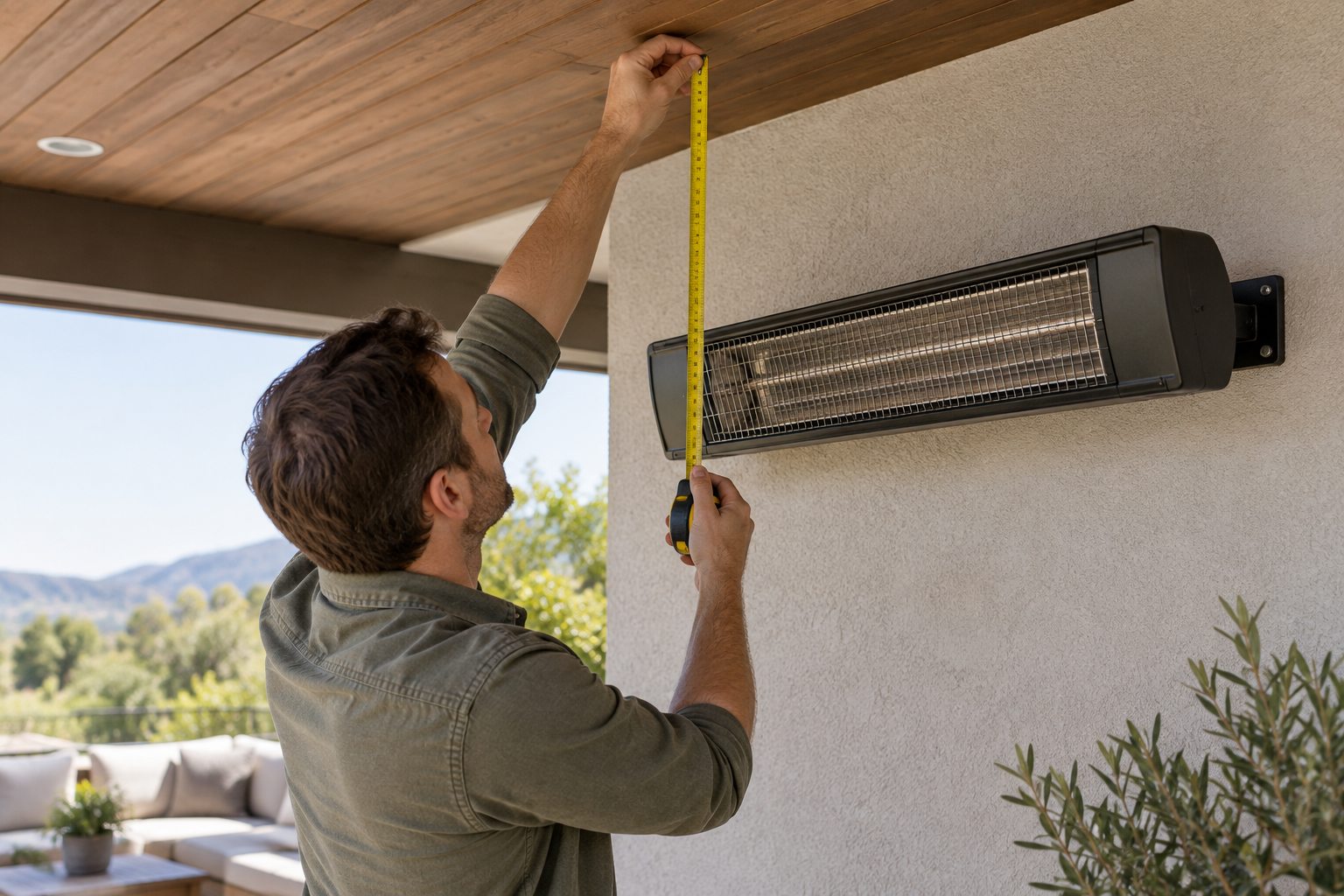
Clearance is the minimum distance between the heater and combustible materials such as a wooden ceiling, beams, walls or fabric. It differs a lot between models:
| Heater (manual) | Above the heater | Sides |
|---|---|---|
| Fire Sense 60262 tabletop | 18 in | 24 in |
| Sunglo A270 | 18 in (ceiling) | 24 in |
| Amazon Basics HLDS01-WCGT | 24 in | 36 in |
| Fire Sense commercial towers | 36 in | 24 in |
| EAST OAK pyramid heater | 36 in | 36 in |
| Mr. Heater MH48PH | 44 in* | 44 in* |
*The Mr. Heater manual gives one minimum clearance of 44 in to combustible materials without saying whether that is above or beside the heater, so we apply it in both directions.
These figures come straight from the manuals. Your heater may differ even within the same brand, so always use the numbers in your own manual. If the manual does not give a ceiling clearance at all, do not guess; contact the manufacturer.
How High Does Your Patio Roof Need to Be?
To check the patio heater ceiling clearance for a propane tower, add the clearance above the heater to the height of the heater itself. You can find the height on the product page or in the spec sheet.
Example: if your tower is 7 ft 5 in tall and the manual requires 36 in of clearance above it, the ceiling must be at least 10 ft 5 in high, measured to the lowest combustible part, such as a beam. Many covered patios are lower than that, which rules out a full-size tower under the roof.
| Heater height (example) | Required clearance | Minimum ceiling height |
|---|---|---|
| 7 ft 5 in tower | 24 in | 9 ft 5 in |
| 7 ft 5 in tower | 36 in | 10 ft 5 in |
| 7 ft 5 in tower | 44 in | 11 ft 1 in |
| 2 ft tabletop on a 30 in table | 18 in | 6 ft |
The heater heights in this table are examples, not the specifications of a particular model. Electric infrared heaters work the other way around: they have a minimum mounting height, and only a small gap to the ceiling. That is why they suit most covered patios much better.
Carbon Monoxide: Why a Propane Heater Needs Open Sides
A propane heater produces carbon monoxide (CO), an odorless gas. The EAST OAK and Fire Sense manuals warn: “Using it in an enclosed space can kill you.” According to the CDC, more than 400 Americans die each year from unintentional carbon monoxide poisoning not linked to fires, and more than 14,000 are hospitalized.
- Keep at least two sides of a covered patio fully open when a propane heater is running.
- Never close side curtains, roll-down shades or winter panels around a burning propane heater.
- Do not use a propane heater when the wind is above 10 mph, as several manuals require; strong wind under a roof can also push exhaust toward seats or doors.
- Install a battery-operated CO alarm nearby. The CPSC recommends CO alarms in the home, and Clackamas Fire District #1 requires at least one CO detector in covered areas with heaters at events.
Wooden Roofs, Awnings, Umbrellas and Pergolas
Patio heater ceiling clearance also depends on what your roof is made of. Not every roof is the same. Wood, vinyl, fabric and plastic can all be damaged by heat, and some can catch fire. A fire report from Technical Safety BC describes how two 40,000 BTU radiant gas heaters set fire to a patio enclosure with wooden trusses because the minimum clearance to the combustible ceiling was not respected.
- Fabric awnings and umbrellas: the International Fire Code, as adopted by cities such as Charleston and Madison, says portable outdoor gas heaters must not be placed beneath, or closer than 5 feet to, combustible overhangs, awnings, sunshades or decorations. These rules mainly target businesses, but they are a sensible benchmark at home.
- Tents and canopies: the same code text prohibits portable gas heaters inside tents, canopies and membrane structures. Clackamas Fire District #1 asks for at least 36 inches between the heater deflector and any tent or awning fabric, and at least 50% of the perimeter open.
- Pergolas: an open pergola without a roof is outdoors, but climbing plants, shade sails and string lights above the heater are combustible. Keep them outside the clearance zone.
- Decorations: keep seasonal decorations well away from any heater. If you are planning outdoor Halloween decorations or outdoor Christmas lights on your patio, plan the heater spot first.
The Best Covered Patio Heater: An Electric Infrared Heater
Bromic, a heater manufacturer, explains that gas-fueled infrared heaters need enough ventilation and cannot be used in an enclosed space, while electric infrared heaters are a great solution for enclosed spaces. That makes an electric infrared heater the safest default covered patio heater. Still, every electric heater has its own installation rules:
| Electric heater | Minimum height | Ceiling | Side wall | In front |
|---|---|---|---|---|
| Dr Infrared DR-238 | 94.5 in | 15.8 in | 19.7 in | 3 ft |
| Infratech W-Series | 6 ft | 12 in | 18 in | 3 ft |
| Bromic Platinum Electric | 72 in (wall), 96 in (ceiling) | see manual | see manual | 3 ft |
| Bromic Tungsten Electric | 96 in | 9.84–13 in | see manual | 3 ft |
| Solaira Alpha H1 | 79 in | 11¾ in | 39½ in | 6 ft |
All figures come from the manufacturer manuals. “In front” is the minimum distance to combustible materials in the direction the heater points.
- Moisture: the Dr Infrared DR-238 is IP55 rated. Infratech recommends hanging its heater under a protective roof or weather cover whenever possible, and Bromic says its Platinum heater must be completely protected against water from above.
- GFCI: the National Electrical Code (NEC 210.8) requires GFCI protection for outdoor receptacles at homes. Solaira also requires weatherproof sockets with ground fault protection.
- No extension cords: the DR-238 manual says never to use the heater with an extension cord.
- Power: plug-in heaters are limited to 1,500 W. Larger heaters are hardwired by an electrician. Our patio heater BTU guide explains how many watts your patio needs.
Mounted Gas Heaters for Covered Patios
Not every gas or propane heater is a portable tower. Some gas heaters are specifically designed to be mounted on a wall or ceiling of a semi-open patio. The Bromic Tungsten Smart-Heat Gas, for example, requires 3 feet of clearance at the sides and a mounting height of 8 feet. With an optional heat deflector, the clearance to the ceiling can be reduced to 14 inches.
These heaters still need natural ventilation: the Bromic manual describes open-air situations where combustion products are rapidly dispersed by wind and natural convection, and it applies the same wall-opening rules as the propane manuals above. They also need professional gas installation. For most homeowners with a typical covered patio, an electric heater is simpler.
Covered Balconies and Apartments
Balconies have their own rules, and they are stricter than many people expect.
- NFPA 1 (10.10.6.1): for buildings other than one- and two-family homes, no grills or similar devices used for cooking, heating or any other purpose may be used on a balcony, under an overhang or within 10 feet of the structure, as quoted by the Nashville and Weston fire departments.
- NFPA 58: propane cylinders larger than the nominal 1 lb size may not be placed on balconies of buildings with two or more homes above the first floor.
- Your lease and HOA: many landlords and homeowners associations add their own rules, and insurers advise checking with your local fire department.
In practice, a propane heater is rarely allowed there, and an electric infrared heater is usually the only option on an apartment balcony, if it is allowed at all. Our propane vs electric patio heater guide compares both types in more detail.
Safety Checklist for a Patio Heater Under a Covered Patio
Patio Heater Types Compared for Covered Patios
| Type | Pros under a roof | Watch out for |
|---|---|---|
| Electric infrared heater (wall or ceiling) | No fumes, saves floor space | Mounting height, rain protection |
| Electric tower | Easy to move, no installation | Needs an outlet, warms a small zone |
| Electric under-table | Warm legs at the table | Low output, keep cloths away |
| Propane tower | High output, no wiring | Tall: needs a high ceiling and open sides |
| Propane tabletop | Low height, portable | Hot top close to the table and ceiling |
| Mounted gas | Powerful, permanent | Professional install, ventilation |
Common Mistakes to Avoid
- Rolling a propane tower under a low patio roof without checking the clearance above it.
- Closing side curtains or winter panels while a propane heater is on.
- Hanging string lights, plants or fabric right above or in front of a heater.
- Mounting an electric heater lower than the minimum height to “feel more heat”.
- Using an extension cord or an outlet without GFCI protection.
- Assuming a balcony is allowed because it has a roof.
Want your covered patio to feel even cozier? Our winter patio ideas include blankets, lighting and wind protection that work together with a heater.
Covered Patio Heaters to Consider
These heaters are part of our best patio heaters comparison. For a patio heater under a covered patio we recommend starting with an infrared heater.
| Heater | Type | Best under a roof for | Link |
|---|---|---|---|
| Dr Infrared DR-238 (1,500 W) | Electric infrared, wall or ceiling | Most covered patios and porches | View on Amazon |
| EAST OAK 1500W tower | Electric, freestanding | Small covered seating areas | View on Amazon |
| EAST OAK 1200W | Electric, under-table | Warm legs at a covered dining table | View on Amazon |
| Amazon Basics 46,000 BTU | Propane tower | Only for the open part of the patio | View on Amazon |
Always compare the installation requirements in the product manual with your own patio before you buy.
Frequently Asked Questions
Can you use a propane patio heater under a covered patio?
Only if the space still counts as outdoors in the manual, for example a roof with no more than two side walls, and if you keep the required clearance to the ceiling. Never use a propane heater in an enclosed porch or garage.
How much clearance does a patio heater need from the ceiling?
It depends on the model. The manuals we read require 18 inches for some tabletop heaters, 24 to 36 inches for most propane towers and 44 inches for the Mr. Heater MH48PH. Electric infrared heaters need much less, for example 15.8 inches for the Dr Infrared DR-238.
What is the best heater for a covered patio?
An electric infrared heater mounted on the wall or ceiling. It produces no fumes and is designed for mounting under a roof, as long as you follow the minimum height and clearances in the manual.
Can I use a patio heater on a screened porch?
A screened porch that stays open to the air may meet the outdoor rules in some manuals, but once you close it in with plastic or glass panels it should be treated as enclosed. Use an electric heater there, never propane.
Can I put a patio heater under a pergola?
An open pergola without a roof counts as outdoors, but keep climbing plants, shade sails, string lights and fabric outside the clearance zone. Under a pergola with a solid or fabric roof, follow the same rules as for a covered patio.
Is a patio heater under a covered patio a fire risk?
It can be when the clearances are ignored. Keep the distances from your manual to the ceiling, walls and anything in front of the heater, keep fabric and decorations out of the clearance zone, and choose an electric infrared heater if your patio roof is low.
Can a patio heater be used under an umbrella or awning?
Not a gas heater. The International Fire Code, as adopted by several U.S. cities, says portable outdoor gas heaters must not be placed beneath or within 5 feet of combustible awnings and sunshades. Fabric can catch fire.
Do I need a carbon monoxide detector for a patio heater?
It is a good idea when you use a propane or gas heater under a roof. The CPSC recommends battery-operated CO alarms, and some fire departments require a CO detector in covered areas with heaters.
Can I use a patio heater on my apartment balcony?
Usually not with propane. NFPA 1 bans heating devices on balconies of buildings other than one- and two-family homes, and NFPA 58 limits propane cylinders above the first floor to the 1 lb size. Check your lease, HOA and local fire department before using an electric heater.
How high should an electric patio heater be mounted?
Follow the manual of your heater. Examples: at least 94.5 inches for the Dr Infrared DR-238, 6 feet for the Infratech W-Series and 8 feet for the Bromic Tungsten Electric.
Can a patio heater damage my patio ceiling?
Yes, if the clearance is too small. Heat can damage wood, vinyl and fabric, and in the worst case start a fire. Technical Safety BC investigated a patio fire caused by gas heaters installed too close to a wooden ceiling.
Can I leave an electric patio heater outside under a covered patio?
Some models, such as the IP55-rated Dr Infrared DR-238, are built for outdoor use. Others must be protected from rain from above. Check the IP rating and the manual of your heater.
Final Thoughts
Yes, you can use a patio heater under a covered patio, but the type of heater makes all the difference. An electric infrared heater is the safest covered patio heater and and most practical choice for most covered patios. A propane heater is only an option when the patio is open enough to count as outdoors and the ceiling is high enough for the required clearance.
Check your manual, measure the patio heater ceiling clearance and keep the clearance zone free of anything that can burn. Then enjoy many more evenings outside. Compare suitable models in our best patio heaters guide.
Sources
- EAST OAK pyramid patio heater manual
- Mr. Heater MH48PH patio heater manual
- Fire Sense commercial patio heater manual
- Fire Sense 60262 tabletop heater manual
- Amazon Basics patio heater manual (HLDS01-WCGT)
- Sunglo A270 manual
- Bromic Tungsten Smart-Heat Gas manual
- Bromic: Can you put a patio heater under a gazebo?
- Bromic Platinum Smart-Heat Electric manual
- Bromic Tungsten Smart-Heat Electric manual
- Infratech W-Series installation instructions
- Solaira Alpha H1 installation instructions
- Dr Infrared Heater DR-238 manual
- CDC: Carbon monoxide poisoning basics
- CPSC: Carbon monoxide safety tips
- Clackamas Fire District #1: Heating guidance
- City of Charleston: Portable outdoor gas-fired heating appliances
- Technical Safety BC: Radiant heater causes patio fire
- Nashville Fire Department: Grills on balconies (NFPA 1)
- City of Caldwell: Propane cylinders on balconies (NFPA 58)
- IAEI Magazine: NEC GFCI requirements (210.8)