How to Store a Garden Hose for Winter: 7 Easy Steps
Drain, coil and store your garden hose before the first hard frost: simple steps for rubber, vinyl and expandable hoses, hose reels and the outdoor faucet, plus the mistakes that crack a hose over winter.
Affiliate disclosure: This guide contains affiliate links to Amazon and links to our buying guides. As an Amazon Associate, we earn from qualifying purchases at no additional cost to you.
One cold night is all it takes. Water left inside a garden hose expands as it freezes, and that can split the hose, crack a fitting or, worse, burst the pipe behind your outdoor faucet. Knowing how to store a garden hose for winter takes about fifteen minutes and saves you a new hose, or a plumber, next spring.
This guide on how to store a garden hose for winter walks you through the seven steps, shows how to drain a garden hose in three quick ways, explains retractable hose reel winter storage and other hose types, and shows how to protect the faucet itself. You will also find a spring checklist for when the season starts again.
When Should You Store a Garden Hose for Winter?
Start garden hose winter storage before the first night that drops below freezing, 32°F. You do not need a fixed date: keep an eye on the 10-day forecast from early fall and pick a dry, mild afternoon just before the first frost. A dry hose on a mild day drains and coils far more easily than a stiff one on a cold morning.
Your local extension service publishes an average first fall frost date for your area, which is a useful reminder to put it on your calendar. In regions where frost is rare, you can keep using the hose through winter, but disconnect and drain it after each use whenever a cold night is forecast.
Garden hose winter storage is one of the jobs in our 12-step fall checklist to winterize your garden. Do it on the same day you shut off the outdoor faucet, so neither gets forgotten.
What Freezing Weather Does to a Garden Hose
Water expands by about 9 percent when it turns to ice. In a hose, that pressure has nowhere to go, so it pushes against the weakest spot: the inner tube, a coupling or the faucet. Cold also changes the hose material itself.
| Part | What can go wrong in winter | How to prevent it |
|---|---|---|
| Hose tube | Ice splits the inner tube; vinyl hoses turn stiff and can crack when bent cold | Drain fully, coil before it gets cold, store indoors |
| Couplings and washers | Ice deforms couplings; rubber washers harden and crack | Remove attachments, check washers before storage |
| Nozzles, splitters and timers | Trapped water cracks plastic housings and valves | Disconnect, open, drain and store them separately |
| Outdoor faucet and pipe | A connected hose traps water; a frozen pipe can burst inside the wall | Disconnect the hose and drain the faucet |
The faucet is the costly part. PRIER, a maker of frost-free faucets, notes that more than 250 gallons of water a day can flow out of a one-eighth-inch rupture in a pipe. A split hose costs you a new hose; a burst pipe can cost you a wall.
How to Store a Garden Hose for Winter in 7 Steps
1. Turn off the water and release the pressure
Close the outdoor faucet. If you use a water timer, switch it off first so it cannot open while you work. Then open the nozzle and let it run until the water stops: a closed spray nozzle keeps the hose under pressure even after the faucet is off.
2. Disconnect the hose and every attachment
Unscrew the hose from the faucet and remove the nozzle, splitter, timer and any quick connectors. Each of these can hold a little water, so winterize garden hose attachments just like the hose itself. Open the nozzle fully and shake it out. Keep small parts and spare washers together in a labeled bag so you can find them in spring.
3. Drain the hose completely
Stretch the hose out and walk the water toward the open end. On a slope, lay it downhill; on flat ground, lift it in loops over your shoulder as you walk along it. See how to drain a garden hose below for three easy methods. An expandable hose should be left to shrink with the nozzle end open.
4. Clean it and check for damage
Wipe off mud, grass and grit with a damp cloth. Giraffe Tools advises a moist cloth without detergents or chemicals for its reel hoses, and that is a safe default for any hose. While you clean, look for cracks, bulges, soft spots and leaking couplings, and check the rubber washer inside each female coupling. Replace a flattened or cracked washer now.
5. Let it dry
Leave the hose in a dry, airy spot for an hour or two before you coil it for good. A damp hose sealed in a bag or box can grow mildew and smell musty in spring.
6. Coil it loosely, without kinks
Coil a standard hose in wide loops of about 2 to 3 feet across, following its natural curve. Avoid tight bends next to the couplings, where hoses crack first. A coil that springs open on its own is too tight. Tie it with a soft strap rather than a wire.
7. Store it indoors and protect the faucet
For garden hose winter storage, hang the coil on a wide hanger or lay it flat on a shelf in a garage, basement or shed that stays dry and, ideally, above freezing. Keep it out of direct sun and away from sharp edges, chemicals and heaters. Then shut off and drain the outdoor faucet, as explained in the faucet section below.
How to Drain a Garden Hose: 3 Easy Ways
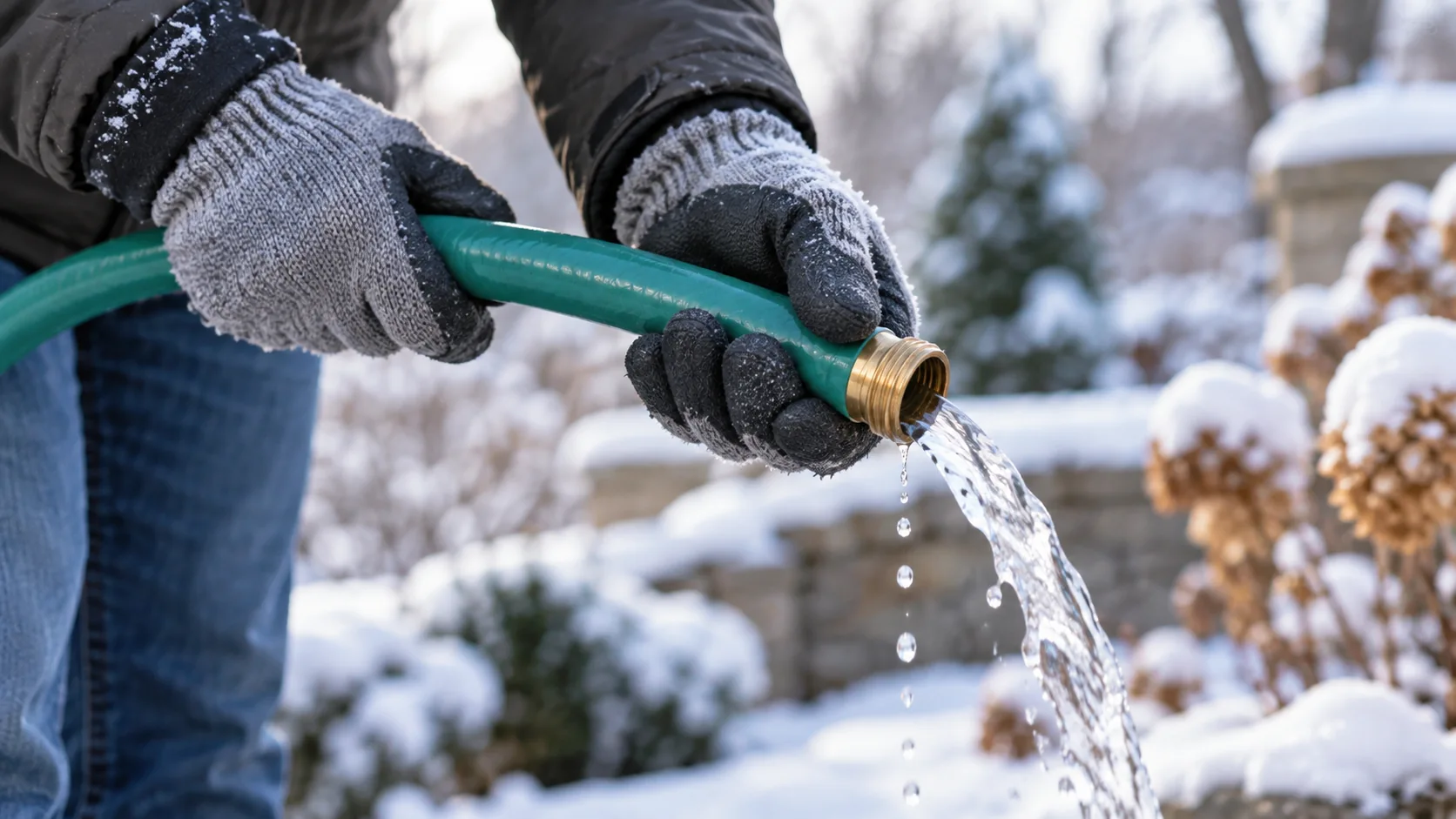
Knowing how to drain a garden hose properly matters: draining is the step most people rush, and the reason most hoses split. Use whichever method suits your yard:
How to Store Each Type of Garden Hose
The steps for how to store a garden hose for winter work for every hose, but each type has its own weak spot. Use this table to adjust your garden hose winter storage routine:
| Hose type | Winter storage | Watch out for |
|---|---|---|
| Rubber hose | Drain, coil in wide loops, store indoors | Heavy when wet; do not hang the full weight on a nail |
| Vinyl hose | Drain and coil while it is still mild outside | Turns stiff in the cold and can crack if bent |
| Expandable hose | Let it shrink fully, drain, dry and store indoors | The thin inner tube is easily damaged by ice and sharp edges |
| Retractable hose reel | Drain, rewind slowly by hand, store the unit indoors | Water left in the lead-in hose and internal fittings |
| Stainless steel hose | Drain and store like a rubber hose | The metal jacket does not stop the inner tube from freezing |
| Soaker hose | Flush, drain, dry and store indoors | Fine pores clog if stored dirty |
Expandable hoses
An expandable hose has a thin latex inner tube inside a fabric cover, which makes it light but more vulnerable to ice. Always store it indoors for winter and keep it away from anything sharp. Our expandable garden hose guide explains why leaks are the most common complaint with this type.
Retractable hose reel winter storage
A reel can hold water in places you cannot see: the lead-in hose, the swivel and the inlet. Giraffe Tools advises turning off the tap, squeezing the nozzle to release pressure, emptying the hose completely and rewinding it slowly by hand, because an unassisted rewind can jam. It then recommends dismantling the unit and storing it indoors, in a safe, dry place. Most wall-mounted reels lift off their bracket for this. See our retractable hose reel guide for models and mounting tips.
Stainless steel hoses
A metal jacket protects against abrasion, not against frost: the inner tube still freezes. Drain and store it indoors like any other hose. Our stainless steel garden hose guide covers how these hoses are built.
How to Winterize Your Outdoor Faucet
Knowing how to store a garden hose for winter is only half the job. The faucet and the pipe behind it are more expensive to repair, and they need draining too. Which steps apply depends on the type of faucet you have.
Frost-free faucet
A frost-free (or freezeless) faucet closes its valve deep inside the warm wall, and the short pipe toward the spout drains itself, but only when nothing is attached. PRIER advises removing hoses, nozzles, splitters and timers before winter, because a connected hose traps water in the line. Some faucets, such as PRIER’s C-434, are designed to drain with a hose attached; check the instructions for your model.
Standard faucet with an indoor shut-off valve
Close the shut-off valve inside the house, then open the outdoor faucet to let the remaining water drain out. If the indoor valve has a small bleeder cap, open it briefly to let trapped water escape. Leave the outdoor faucet open over winter so any water left can expand without damage.
Add a faucet cover
An insulated faucet cover adds a layer of protection against cold and wind. It is extra insulation, not a replacement for draining, and it only fits properly once the hose is off. Not sure what type of faucet you have, or see a drip that will not stop? Ask a plumber before the first hard freeze.
Where Is the Best Place for Garden Hose Winter Storage?
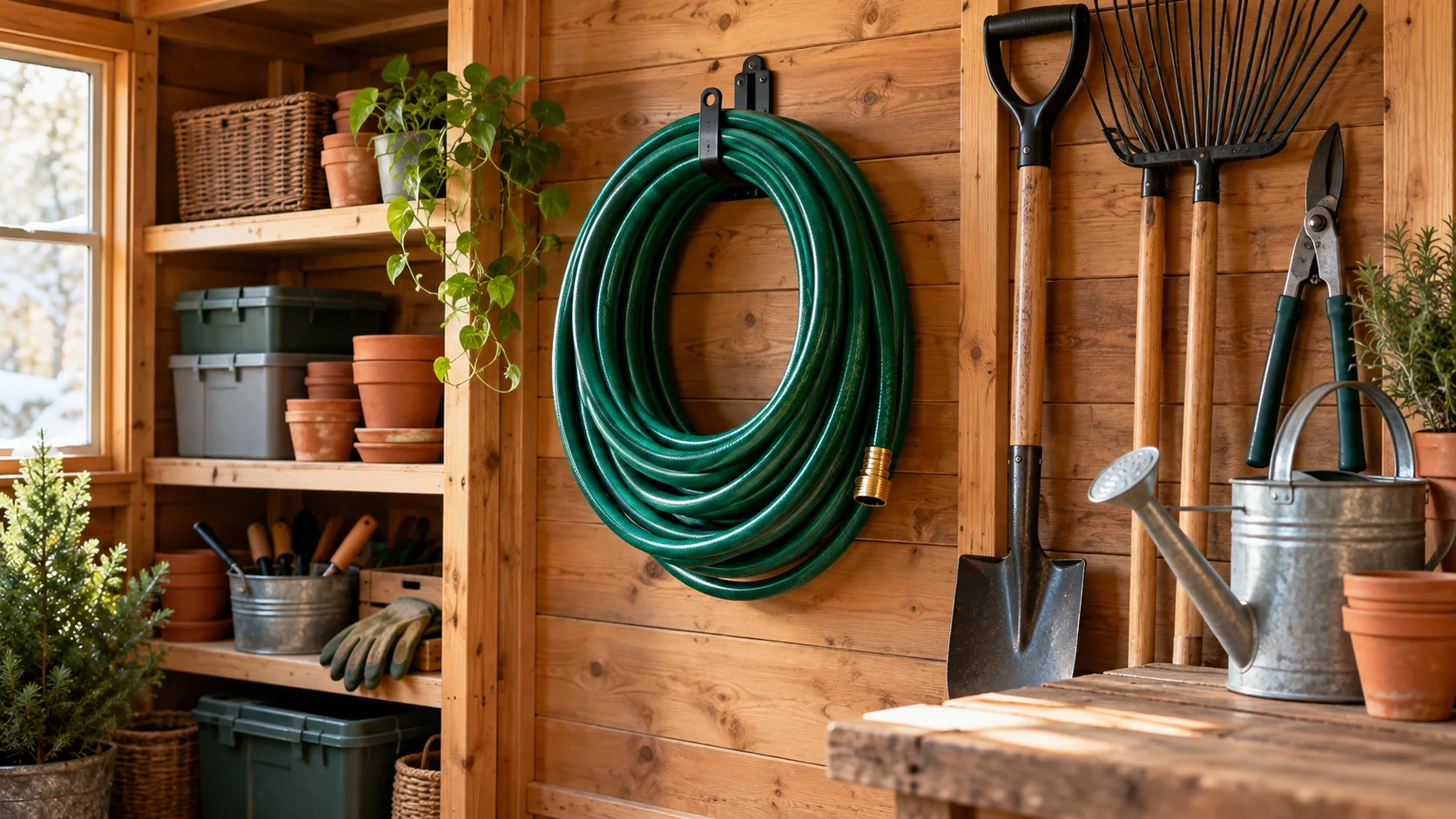
The best spot for garden hose winter storage is dry, dark and above freezing. Most hoses do not need a heated room, but every degree above freezing protects the couplings and washers.
| Location | Good for | Check first |
|---|---|---|
| Basement or utility room | The safest choice for every hose and reel | Dry floor, no sharp tools or chemicals nearby |
| Attached garage | Most hoses, hung on a wall or on a shelf | An unheated garage can still drop below freezing |
| Garden shed | Drained rubber hoses in milder regions | Frost, damp and mice; less suitable for expandable hoses |
| Deck box or hose pot outside | Mild climates only | It keeps rain off but does not stop freezing |
Hang the coil on a wide, rounded hanger so the hose keeps a gentle curve. A narrow nail or hook pinches the hose and creates a weak spot. If you lay it on a shelf, keep heavy items off the coil. Once the hose is completely dry, you can screw the two ends together to keep insects and dirt out.
What to Do If Your Hose Is Already Frozen
Do not force it. A frozen hose is brittle, and bending or uncoiling it can crack the tube.
- Turn off the water at the faucet first.
- Leave a frozen coupling on the faucet until it thaws; twisting it can damage the faucet threads.
- Thaw the hose slowly in a garage or basement, on a tray or old towel, without unrolling it.
- Avoid quick heat: no hair dryer, heat gun, open flame or boiling water.
- Inspect it once thawed: drain it, check for splits and leaking couplings, and then follow the steps on how to store a garden hose for winter above.
If the faucet was frozen with the hose attached, check the wall behind it for damp spots and watch for leaks the first time you turn it on. A burst pipe inside the wall is a job for a plumber.
A Simple Spring Restart Checklist
- Wait until the last frost has passed in your area.
- Check the hose and couplings for cracks, and replace hardened washers.
- Turn the outdoor faucet back on slowly and check for drips at the faucet and inside the wall.
- Reconnect the hose, nozzle and timer, and test them before leaving them under pressure.
- Remount a retractable reel on its bracket following the manual.
A worn nozzle is an easy spring upgrade; compare models in our garden hose nozzle guide. Then plan your season with how often to water your garden.
Common Garden Hose Winter Storage Mistakes
- Leaving the hose attached to the faucet overnight when frost is forecast.
- Coiling the hose with water still inside it.
- Forgetting to winterize garden hose attachments such as the nozzle, splitter or timer, which crack just as easily as the hose.
- Coiling a vinyl hose on a cold morning, when it is stiff and cracks.
- Hanging a heavy, wet coil on a single nail.
- Storing an expandable hose in an unheated shed with sharp tools.
- Using a faucet cover instead of draining the faucet.
- Putting automotive antifreeze in a hose or reel. Giraffe Tools warns that antifreeze can erode the internal parts of its reels.
Garden Hose Winter Storage Helpers to Consider
You do not need new gear to winterize garden hose equipment well, but these items solve the two most common problems: a hose without a proper hanger and an exposed outdoor faucet.
| Product | Helps with | Good to know | Link |
|---|---|---|---|
| Liberty Garden 681 hose hanger | A wide, rounded hanger for a drained coil in the garage or basement | Stainless steel; holds 125 ft of 5/8-inch hose | View on Amazon |
| Frost King FC1 faucet cover | Extra insulation for an outdoor faucet after draining | Foam shell; fits once the hose is removed | View on Amazon |
| Giraffe Tools 130 ft retractable reel | Keeping the hose tidy all season, then storing it indoors for winter | Giraffe advises draining and indoor winter storage | View on Amazon |
Thinking about replacing a worn hose before spring? Compare a light expandable hose and a wall-mounted reel in our expandable vs retractable hose guide.
Frequently Asked Questions
Can I leave my garden hose outside in winter?
Not if you get freezing nights. Water left inside can freeze, split the hose and crack the couplings, and a hose left on the faucet can stop it from draining. Drain the hose and store it indoors. In frost-free regions you can leave it out, but disconnect and drain it whenever a cold night is forecast.
At what temperature will a garden hose freeze?
Water freezes at 32°F. A full hose can freeze on a single night below that, and a hose lying on cold ground or in the wind freezes faster. Put the hose away before the first frost rather than waiting for a hard freeze.
Is it OK to store a garden hose in the garage?
Yes, as long as the hose is fully drained and dry. For garden hose winter storage, an attached garage usually stays warmer than the outside air, but an unheated garage can still drop below freezing, so a basement is safer for expandable hoses and reels.
How do you drain a garden hose before winter?
Here is how to drain a garden hose: turn off the water, open the nozzle to release the pressure and disconnect the hose. Then walk the water out: lift the hose in loops over your shoulder, or lay it down a slope with the open end lowest and wait 10 to 15 minutes.
Can I leave a hose connected to a frost-free faucet in winter?
No, in most cases. A frost-free faucet can only drain when nothing is attached. PRIER advises removing hoses and attachments for winter. A few models are designed to drain with a hose attached, so check the instructions for your faucet.
Does a faucet cover stop an outdoor faucet from freezing?
It helps, but it is not enough on its own. A faucet cover adds insulation; it does not remove the water. Drain the faucet first and then fit the cover.
Can I store an expandable hose outside in winter?
It is better not to. The thin inner tube of an expandable hose is easily damaged by ice. Let it shrink fully, drain it, let it dry and store it indoors.
How do I winterize a retractable hose reel?
For retractable hose reel winter storage, turn off the water, release the pressure at the nozzle and empty the hose completely. Rewind it slowly by hand. Giraffe Tools then recommends storing the reel indoors in a dry place for the winter.
Should I put antifreeze in my garden hose?
No. Knowing how to drain a garden hose properly is enough, and antifreeze can damage hoses and reels. Giraffe Tools specifically warns that antifreeze can erode the internal parts of its reels.
Do I need to winterize garden hose nozzles and timers too?
Yes. Nozzles, splitters and timers hold a little water and crack just as easily as the hose. Disconnect them, open them to drain and store them indoors with the hose.
Should I connect the two ends of the hose together for winter?
You can, once the hose is completely dry inside. Joining the ends keeps insects and dirt out. Never connect them while water is still inside.
How should I coil a garden hose for storage?
Coil it in wide loops of about 2 to 3 feet across, following its natural curve, and avoid tight bends near the couplings. Hang the coil on a wide, rounded hanger or lay it flat on a shelf.
Final Thoughts
Learning how to store a garden hose for winter comes down to three things: no water inside, no tight bends and no frost. Drain the hose, coil it loosely, keep it indoors and drain the outdoor faucet on the same day. Once you know how to drain a garden hose and where to keep it, the whole job takes about fifteen minutes. Fifteen minutes in the fall means a hose that works on the first warm day of spring.
Ready for the rest of the garden? Work through our fall winterizing checklist, and if your hose did not survive last winter, compare options in our expandable vs retractable hose guide.
Sources
- PRIER: Disconnecting hoses and attachments for winter
- Giraffe Tools: Winter maintenance guide for retractable hose reels
- Liberty Garden: Model 681 stainless hose hanger
- Frost King: FC1 foam faucet cover
- Giraffe Tools: 130 ft retractable garden hose reel